
Table of Contents
ToggleThe Horizon franchise has become a heavyweight in open-world gaming, and if you’re trying to figure out which entry is worth your gaming hours, you’re asking the right question. Aloy’s journey across post-apocalyptic worlds has evolved dramatically from Guerrilla Games’ original 2017 debut, and the leap to Forbidden West (released in 2022) isn’t just a graphical bump, it’s a fundamental reimagining of how the series approaches exploration, combat, and storytelling. Whether you’re planning your first playthrough, want to replay the series, or simply can’t decide which game to invest your time in, understanding the differences between Horizon Zero Dawn and Forbidden West is crucial. Both are exceptional games, but they’re different beasts, and your experience will depend on what you value most: the foundation that started it all, or the refined, ambitious sequel that pushes everything further.
Key Takeaways
- Horizon Zero Dawn delivers a tighter, more focused narrative with a 30-35 hour campaign, making it the ideal entry point for understanding the franchise’s foundation and story mysteries.
- Horizon Forbidden West expands on every front with improved combat mechanics, massive skill trees supporting multiple character builds, and enhanced traversal tools like the Shieldwing and Pullcaster.
- Forbidden West’s visuals on PS5 and PC showcase next-gen capabilities with ray-tracing, volumetric fog, and detailed environments, though the PS4 version compromises significantly on resolution and draw distance.
- Zero Dawn’s straightforward combat emphasizes positioning and resource management, while Forbidden West’s kinetic gameplay introduces complex status effects and explosive machine encounters that demand tactical depth.
- Character development is dramatically stronger in Forbidden West, with meaningful supporting cast arcs and deeper Aloy development, whereas Zero Dawn focuses more on mystery and world-building.
- Play Zero Dawn first for proper narrative coherence and appreciation of improvements, but Forbidden West offers superior mechanics and current-gen content if you prioritize gameplay refinement over story fundamentals.
Game Overview And Release Timeline
Horizon Zero Dawn: The Original Adventure
Horizon Zero Dawn hit shelves in February 2017 as a PlayStation 4 exclusive and later arrived on PC in 2021. The game introduced players to Aloy, a young outcast archer navigating a lush, monster-filled world where nature has reclaimed civilization and mechanical creatures have replaced traditional wildlife. It was a fresh take on the open-world formula, mechanically interesting, visually stunning, and narratively compelling enough to hook millions of players.
The original’s success came from its balance. Combat felt purposeful: exploration rewarded curiosity: the story unfolded with genuine mystery. The game wasn’t revolutionary in structure, but its execution and the world Guerrilla Games built were undeniably polished. Across all platforms, it sold over 10 million copies, cementing Aloy as a memorable protagonist and proving that original IPs could still dominate in a crowded market.
Horizon Forbidden West: The Evolved Sequel
Horizon Forbidden West launched in February 2022 on PlayStation 4 and PS5, with a PC port arriving in March 2024. The sequel picks up roughly six months after Zero Dawn’s ending and follows Aloy as she travels west toward San Francisco Bay, seeking a way to save a dying Earth from a mysterious plague known as the Red Blight.
Forbidden West expands on nearly every front: a larger world, more machine types, refined combat mechanics, and production values that showcase what next-gen hardware can deliver. The game is unquestionably more ambitious, with deeper skill trees, weapon crafting systems, and survival mechanics that demand more tactical thinking. Critical reception was strong, though some felt the story pacing suffered from the expanded scope. As of 2026, Forbidden West remains Guerrilla Games’ flagship title and continues to receive post-launch support and content updates across all platforms.
Story And Narrative Differences
Zero Dawn’s Plot And World Building
Horizon Zero Dawn tells a tightly focused story about Aloy’s origins and the mystery behind the Old World’s collapse. The narrative unfolds across three acts, each peeling back layers of lore about APOLLO, GAIA, and the machine rebellion that reshaped Earth. The pacing is tight, the main campaign typically runs 30-35 hours for a thorough playthrough, and revelations land with impact because the game doesn’t bog you down with side content distractions.
The world-building is phenomenal. Holographic echoes from before the apocalypse piece together humanity’s final days. Machine designs carry biological logic that gradually becomes clear. The native cultures you encounter feel distinct and purposeful, not just color-swapped NPCs. Zero Dawn’s strength is its focus: it tells one coherent story in a intriguing realm without padding the narrative.
Forbidden West’s Expanded Storyline
Forbidden West inherits the setup but expands it dramatically. The Red Blight threat feels more immediate, and Aloy’s quest has higher stakes, preventing a second extinction event. The story explores themes of grief, legacy, and what it means to be human in a world where artificial intelligence shaped mankind’s fate.
But, the expanded narrative comes with trade-offs. With a 40-50 hour campaign (depending on your pace) and significantly more side quests, the main story can feel diluted. Cutscenes sometimes interrupt momentum just when momentum felt strong. The emotional beats are there, particularly involving key characters, but they’re spaced further apart by mandatory exploration and filler side content.
Forbidden West does excel at character development, introducing allies with actual depth and relationships that evolve through dialogue and mission arcs. The supporting cast is leagues ahead of Zero Dawn’s, which means you’ll care more about their outcomes. But if narrative pacing matters to you, Zero Dawn’s leaner approach has merit.
Gameplay Mechanics And Combat Systems
Zero Dawn’s Combat Approach
Zero Dawn uses a straightforward but engaging combat loop: scan enemies with your Focus tool to identify weak points, equip the right weapon for the job, and execute. The arsenal feels limited compared to Forbidden West, you’re working with bows, slings, and rope casters primarily, but that constraint forces interesting decision-making. Combat favors positioning, ammo management, and understanding each machine’s behavioral patterns.
Difficulty scaling is generous. On Normal, mistakes are forgivable: on Hard, you’ll die if you’re careless: on Ultra Hard (unlocked post-game), every encounter becomes a chess match. The skill tree offers meaningful upgrades but isn’t overwhelming. You’ll unlock abilities like enhanced stealth, better handling of status effects, and improved crafting efficiency, but none of them feel mandatory, you can succeed without them.
Exploration feels organic. There’s no quest marker spam, and finding new areas rewards curiosity with machine sites, ancient ruins, and valuable loot. The climbing and platforming are functional but simple: this isn’t a parkour game.
Forbidden West’s Enhanced Mechanics
Forbidden West overhauls nearly everything. The weapon variety explodes, spike throwers, sticky bombs, purgewater dispensers, melee weapons with unique abilities, and crafting becomes central to survival. You’re gathering resources constantly, creating ammo on the fly, and managing consumables more carefully. This adds complexity that some find engaging and others find busywork-adjacent.
The skill tree is massive, with three skill categories (Prowess, Valor, and Trapper) offering 40+ upgrades per tree. Character builds become viable. You can spec into a heavy-armor tank, a ranged critical hit specialist, or a stealth archer. Zero Dawn didn’t really support “builds” like this, everyone played similarly. Forbidden West encourages varied approaches.
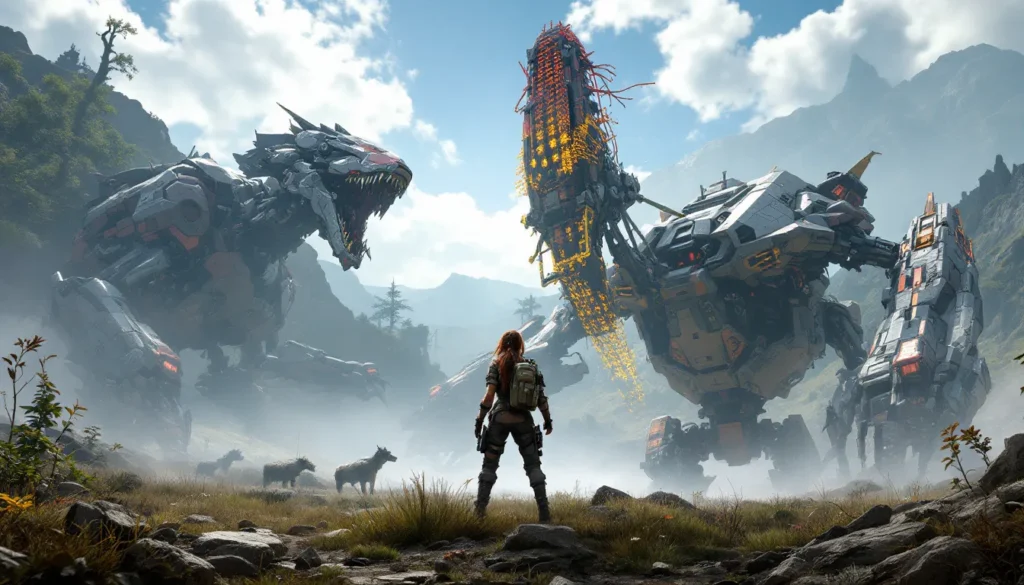
Combat is more kinetic and explosive. Machine encounters feel like full engagements rather than puzzle-solving: you’re managing fireworks of status effects, explosions, and machine part destructions simultaneously. It’s visually impressive but demands more from you mechanically. On Hard and above, resource management becomes brutal.
Traversal options expand significantly. The Pullcaster lets you yank machines and objects, the Shieldwing enables gliding, and climbing feels more fluid. The map design supports these tools, making navigation feel less linear than Zero Dawn.
Link to detailed Forbidden West mechanics: Experiencing deeper combat systems in the sequel transforms how you approach encounters.
Graphics, Visuals, And Technical Performance
Environmental Design And Aesthetics
Horizon Zero Dawn launched on PS4 in 2017, and its visuals still hold up remarkably well. The art direction is phenomenal, dense forests, deserted ruins, and rolling grasslands feel distinct and alive. Machine designs carry biomechanical elegance: every robotic creature looks like it evolved naturally, not just a designer’s whim.
The game’s aesthetic is grounded. There’s no neon overload or sci-fi excess: the world reclamation theme feels authentic. Holographic interfaces pop against the organic landscape. Weather systems add atmosphere, storms roll in, lighting shifts, and your visibility changes dynamically.
Forbidden West pushes this further on hardware capable of handling it. PS5 and PC versions deliver genuinely next-gen visuals: ray-tracing reflections in water, volumetric fog that moves realistically, character models with intricate detail, and draw distances that stretch across entire valleys. The San Francisco Bay Area biome, jungle regions, and desert wastes show off environmental variety. Every cutscene is rendered in-engine, which means the visual quality never dips when story moments hit.
The PS4 version of Forbidden West, though, tells a different story. It’s still visually competent but trades resolution and texel density for frame stability. Trees lack detail at range, shadows become blocky, and pop-in becomes noticeable. If you’re comparing apples-to-apples (PS4 Zero Dawn vs. PS4 Forbidden West), the leap is less dramatic than PS5/PC would suggest.
Frame Rate, Resolution, And Optimization
Zero Dawn targets 30fps at 1440p-1800p on PS4, though it fluctuates. On PS5 (via backwards compatibility), it runs significantly smoother. The PC version scales up to 4K/120fps depending on your hardware, with solid optimization from the port team.
Forbidden West offers performance modes on PS5: a 60fps Performance mode that holds at 1440p upscaled, and a 30fps Fidelity mode that renders at 2160p native. The difference is noticeable, 30fps Fidelity looks stunning but feels sluggish in combat: 60fps Performance is responsive but slightly less detailed. Most reviewers recommend the 60fps mode for action sequences. The PC version, reviewed at Metacritic, received praise for technical optimization, hitting 100+ fps on high-end rigs while remaining playable on mid-range systems.
The PS4 version of Forbidden West struggles in dense areas, sometimes dipping below 30fps. If you’re deciding between versions in 2026, PC, PS5, or even Steam Deck (with caveats) are superior choices to the base PS4 build.
Character Development And World Exploration
Protagonist And Supporting Characters
Horizon Zero Dawn centers on Aloy, and while she’s likable and capable, her character arc is relatively straightforward. She’s driven by a desire to understand her origin and prove herself: the story fulfills that arc completely by the ending. Supporting characters exist but rarely transcend their archetypal roles. Erend the Oseram warrior, Varl the Nora hunter, and Sylens the Mysterious Mentor are all well-voiced and memorable, but they don’t have sustained arcs beyond their introductions.
Aloy’s personality shines through dialogue options (which are limited) and her observations while traversing the world. She grows curious, skeptical, and eventually determined, but this development happens passively through story beats rather than through extended character interactions.
Forbidden West deepens Aloy significantly. She’s no longer a newcomer to this world: she’s a seasoned explorer wrestling with trauma, responsibility, and the weight of saving humanity. The dialogue system offers more nuance, and her responses reflect her journey. Interactions with returning characters like Erend and new allies such as Zo, Kotallo, and Ulvund carry real weight. These relationships develop across multiple scenes, and their personal struggles matter. Aloy actually discusses her feelings rather than remaining stoic.
The supporting cast is dramatically improved. Companions feel like distinct personalities with conflicting perspectives. Their quest lines provide character depth that Zero Dawn simply didn’t offer. By Forbidden West’s end, you’ve genuinely cared about these characters’ outcomes, something Zero Dawn’s cast couldn’t quite achieve.
Map Size, Open World Features, And Traversal
Zero Dawn’s open world is roughly 60 square kilometers, which was substantial for 2017. The map is layered with height variation, making the perceived size larger. Machine sites, ancient ruins, and hidden machines reward exploration. The Focus scanner reveals nearby points of interest, and curiosity is genuinely rewarded, you’ll find weapons, armor, and lore if you’re willing to explore off the beaten path.
Traversal is functional. Climbing feels physics-based, parkour is minimal, and gliding doesn’t exist. You navigate the world on foot, which can feel slow during traversal-heavy sections.
Forbidden West expands the map to approximately 90 square kilometers across varied biomes. The Bay Area region, jungles, deserts, and volcanic zones create visual diversity. The map design is tighter and more verticality-focused, meaning less empty space between points of interest.
The Shieldwing transforms traversal. Gliding from high points saves time and opens new shortcuts. The Pullcaster enables environmental puzzles and shortcuts. Climbing is more robust. Fast travel is available at campfires, reducing unnecessary traversal tedium. The combination makes exploring feel less tedious and more rewarding.
Speaking of exploration, comprehensive quest guides help navigate Forbidden West’s expanded world if you’re feeling overwhelmed. Zero Dawn requires less guidance due to its tighter design.
Difficulty, Accessibility, And Replay Value
Difficulty Settings And Learning Curve
Zero Dawn offers four difficulty levels: Easy, Normal, Hard, and Ultra Hard (post-game unlock). The learning curve is forgiving on Normal, the game teaches you progressively, and mistakes are rarely punishing. Enemy behavior is readable and consistent: you can predict attack patterns after observing a few encounters.
On Ultra Hard, Zero Dawn becomes genuinely challenging. Machines are aggressive, ammo is scarce, and mistakes cascade into defeats. Skill expression matters, positioning, resource management, and understanding each machine’s weak points become essential. Players report 10-20 additional hours to complete Ultra Hard compared to Normal, and the satisfaction is real.
Forbidden West also provides Easy, Normal, Hard, and Ultra Hard. But, the learning curve is steeper. The expanded weapon variety and skill trees mean new players can easily overwhelm themselves with options. Status effects (burning, chilled, shock, corruption) add another layer of complexity that takes time to internalize. Normal difficulty is still manageable for experienced players but demands more attention than Zero Dawn’s Normal.
Ultra Hard in Forbidden West is noticeably harder than Zero Dawn’s equivalent. Enemy aggression is ramped up, resource availability is lower, and status effects apply more frequently. A skilled player might spend 50+ hours completing Forbidden West on Ultra Hard compared to 30-35 hours on Normal.
Accessibility Options And Replayability
Zero Dawn includes accessibility features: remappable controls, colorblind modes, HUD customization, and difficulty modifiers that let you tune specific challenges. It’s solid but not comprehensive by modern standards.
Forbidden West significantly expanded accessibility. Options include enhanced audio cues, visual notifications for incoming attacks, button remapping, toggle options for held buttons, and even a “no machine hunting” mode for story-focused players. The New Game+ mode carries over your skills and weapons, offering a harder experience with familiar tools. Permadeath mode was added post-launch. These additions make Forbidden West more replayable for different playstyles.
For pure replayability, Forbidden West edges out Zero Dawn due to skill build variety and New Game+ features. But, Zero Dawn’s tighter story and pacing make replaying it feel less tedious on subsequent runs. Both games support multiple playthroughs, but Forbidden West offers more mechanical reasons to return.
Platform Availability And System Requirements
Horizon Zero Dawn is available on:
- PlayStation 4 and 5 (native PS5 enhanced version)
- PC (Steam and Epic Games Store)
- Mobile (PlayStation Now cloud streaming)
PC system requirements are reasonable. You can play on modern mid-range hardware at 60fps on high settings. The port is stable and rarely encounters major issues.
Horizon Forbidden West availability is more restricted:
- PlayStation 4 and 5 (PS5 recommended: PS4 version has performance compromises)
- PC (Steam, Epic Games Store, as of March 2024)
- Steam Deck (playable in verified status with caveats: performance mode required)
- PlayStation Plus Premium (cloud streaming)
The PC version demands more than Zero Dawn. You’ll want at least an RTX 2080 or equivalent for 1080p/60fps at high settings. Ray tracing options exist but tank performance on mid-range GPUs. Steam Deck compatibility is notable for Forbidden West, making it the first mainline entry playable on Valve’s handheld.
One thing to note: Forbidden West isn’t available on Xbox. If you’re exclusive to Microsoft’s ecosystem, Zero Dawn is an option (through Game Pass), but Forbidden West isn’t. This is a significant factor if platform exclusivity affects your purchasing decision. Alternatively, PC ports offer cross-platform flexibility for both games.
Which Game Should You Play First
Start with Horizon Zero Dawn if:
- You want to understand the franchise’s foundation and appreciate the narrative progression
- You prefer leaner, more focused experiences with tighter pacing
- You’re on a budget (it’s significantly cheaper now, often $10-20)
- You value story mystery and world-building setup over mechanical depth
- You have limited time: Zero Dawn respects your hours more efficiently
- You’re starting a franchise you want to complete in order
Jump to Horizon Forbidden West if:
- You own a PS5 or high-end PC and want next-gen showcase material
- You prioritize gameplay refinement, combat complexity, and build variety over story fundamentals
- You’ve already played Zero Dawn and want the sequel’s improvements
- You’re interested in competitive difficulty challenges and want the harder Forbidden West Ultra Hard experience
- You want current-gen content with ongoing post-launch support and updates
- You’re exploring the franchise casually and don’t need the narrative foundation
The honest take: Playing Zero Dawn first is the safer choice. You’ll appreciate Forbidden West’s improvements more: you’ll understand character references and lore callbacks: the story flows as intended. But, Forbidden West’s combat and exploration are meaningfully better, and if narrative isn’t your priority, jumping straight there won’t ruin your experience.
From a 2026 perspective, broader open-world comparison guides might help if you’re torn between these and other franchises. But within the Horizon series specifically, the sequence matters primarily for story coherence.
Conclusion
Horizon Zero Dawn and Forbidden West are both exceptional games, but they serve different purposes. Zero Dawn is the leaner, tighter entry that prioritizes narrative focus and world mystery. It introduced Aloy and her world with remarkable balance. Forbidden West is the ambitious sequel that refines combat, expands exploration, and deepens character relationships at the cost of some pacing.
Neither game is objectively “better.” Your choice depends on what you value: story coherence and efficiency lean toward Zero Dawn, while mechanical depth and visual spectacle favor Forbidden West. Ideally, both should be played in sequence to get the full experience. But if you’re short on time or gaming budget, know that Zero Dawn provides the more complete, self-contained experience, while Forbidden West delivers the most refined moment-to-moment gameplay the series has achieved.
In 2026, both titles remain relevant and exceptional. Pick the one that aligns with your priorities, and you won’t regret it.